

Should Your Business Own the Car?
A simple framework for thinking about business vehicles and why “put the car in the business” is usually a bad idea.

A common bit of questionable tax advice floating around the internet goes something like this:
Put your car in your business so you can deduct it.
Fraudulent reporting of excess business usage of a vehicle aside, does it ever make sense to own and operate a vehicle in a business, and if so, when?
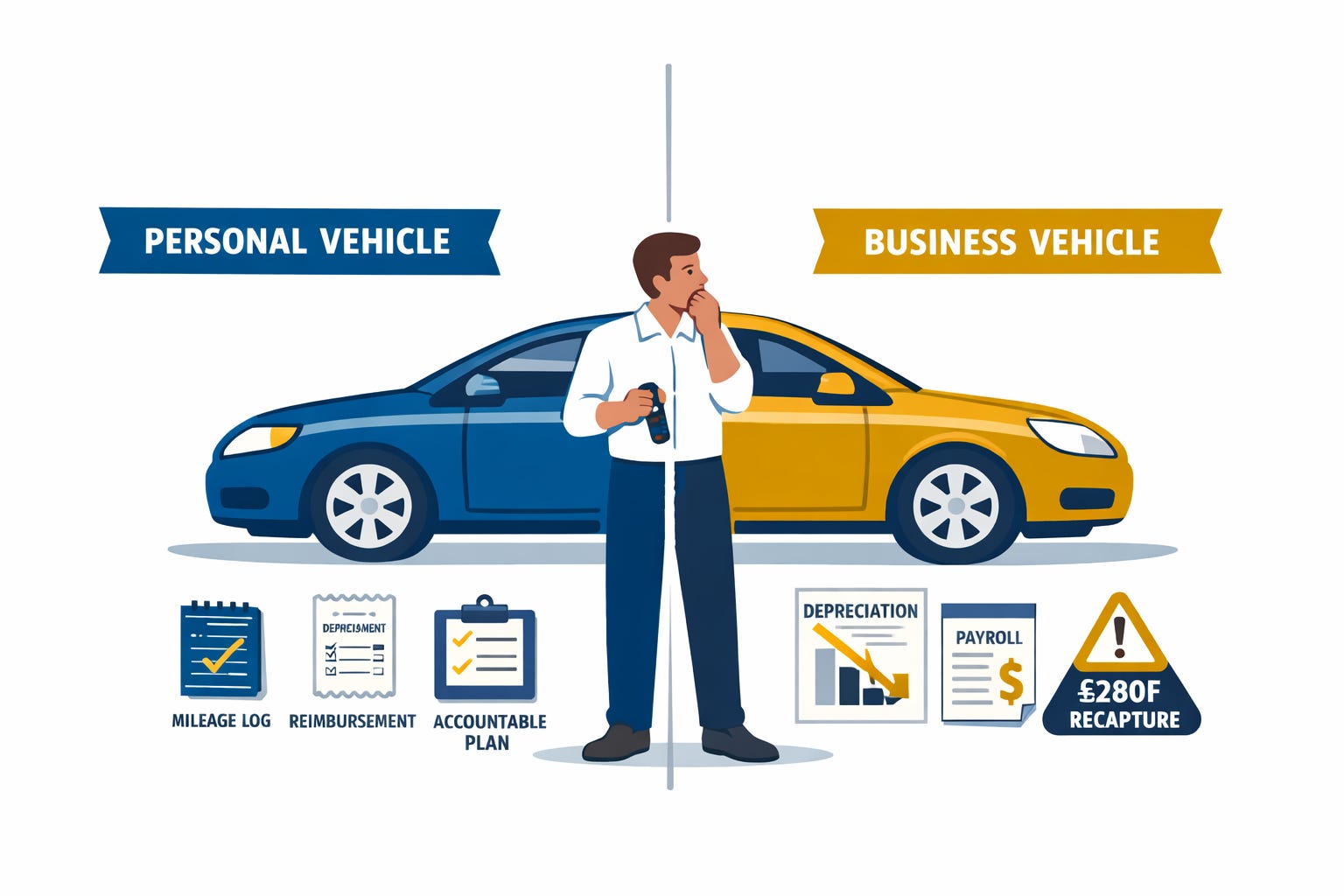
In general, I usually recommend against this approach, unless there is some compelling reason to follow it. In many small business situations I see—especially with S corporations—the shareholder owning the vehicle personally and being reimbursed by the business is often the cleaner and more defensible structure.
But, as with all things tax, the answer depends on the specific facts and circumstances of the situation. So, when I’m advising a client about the business use of a vehicle, I use a simple framework that helps me sort through these questions quickly.
The framework boils down to three questions:
Who owns the vehicle?
Who uses the vehicle and how?
What percentage of use is for business, and how will that change over time?
These three variables determine almost every tax consequence involving business vehicles: deductions, depreciation, income inclusion, and sometimes recapture.
I’ll unpack this framework in more detail in an upcoming episode of Tax in Action. I’m also teaching a webinar for NAEA on the topic in June. But I’m curious how other practitioners think about these situations. So, if you have a way of handling clients who insist on treating their grocery haulers as if they’re company cars, I’d love to hear it!
Let’s look at a few real situations to see how the framework clarifies how I think about the tax treatment of a vehicle.
Occasional business use of a personally-owned vehicle
A typical situation for my practice looks like this: A service-based S corporation with a sole shareholder-employee who occasionally drives her personally-owned vehicle for business purposes, such as meeting clients.
Let’s break this down:
The shareholder-employee owns the vehicle.
She also exclusively uses the vehicle for both business and personal purposes.
Business use percentage is relatively low and will likely remain low for the foreseeable future.
I generally recommend using an accountable plan in situations like this.1 The plan allows the business to provide a tax-free, deductible reimbursement to the shareholder-employee for the business use of her personal vehicle. I typically recommend reimbursing at the IRS standard mileage rate.
Occasional personal use of a company-owned vehicle
A less common, but still plausible, situation involves some personal use of a company-owned car. This can make sense under the right conditions, as long as the business diligently tracks and correctly reports personal use.
What happens when the business owner-employee primarily uses the vehicle for business, but also drives it on weekends and vacations? Let’s take a look:
The business owns the vehicle.
The owner primarily uses the vehicle for business, with some limited personal use.
Business use percentage is relatively high and will likely remain high for the foreseeable future.
The business use of the company provided-vehicle is a working condition fringe benefit.2 The owner must substantiate the use of the vehicle, such as with a mileage log.3
Any personal use of the vehicle results in the inclusion of the value of that usage in the owner’s taxable wages. This means coordinating the owner’s mileage log with payroll, introducing additional complexity.
Variable business use over time
Now consider a vehicle initially treated as a company-owned vehicle. The business claimed accelerated depreciation because business use exceeded 50 percent.
Two years later, both the business and the owner’s personal life have changed, and business use falls below 50 percent.
This can trigger recapture of the “excess depreciation” claimed in prior years, which could have significant tax and financial consequences.4
Exceptions to the general recommendation
To be clear, I’m not saying the business should never own the vehicle. There are situations where corporate ownership may make sense.
But, in my experience, too many vehicle structures are chosen without thinking through the interaction between ownership, use, and business-use percentage.
I want to know how you think about these situations.
When a client asks about a “business vehicle,” what factors do you look at first?
What mistakes have you seen recently?
What’s the strangest vehicle deduction you’ve seen recently?
What’s the best—or worst—business vehicle story from your practice?
See Reg. § 1.62–2 for the accountable plan rules. Note that the Tax Cuts and Jobs Act of 2017 suspended miscellaneous itemized deductions, including unreimbursed employee expenses. This leaves accountable plans as the preferred way to handle these expenses.
See Reg. § 1.132–5(b) for the rules regarding an employer-provided vehicle.
See Reg. § 1.132–5(d)(1), which refers to IRC § 274(d), for the strict substantiation requirement.
See IRC § 280F(b).
A common misconception is that business owners believe that if a vehicle is under the business name, they no longer need to maintain a mileage log.